
Getting up at 5 a.m.: how I do it every day
Getting up at 5 a.m. every day: how I do it, what research says healthy sleep is and why a third of people in Switzerland sleep badly.

Getting up at 5 a.m. starts the evening before. I get up at 5 every day because I'm asleep by 10 p.m. My method is very simple: NULLRAUSCHEN before sleep, a calm book, a clear head. This is not medical advice. I'll show you how I do it, what research says healthy sleep is and why so many people in Switzerland sleep badly.
How do I get up at 5 a.m. every day?
My night usually runs from 10 p.m. to 5 a.m. Seven hours. The alarm clock isn't the trick. The trick is the evening.
Before sleep I do NULLRAUSCHEN, which means "zero noise": a calm book and a clear head. That's all there is to it. NULLRAUSCHEN is also the name of my silent retreat in January 2028.
The night before 26 November I slept only 6 hours. But what 6 hours! It was a real adventure.
Magnesium and taurine, in my case with a few brewed herbs, only help me let myself fall into the arms of a sleepy euphoria.
Sleep is not a break from life. It is your second self.
What is healthy sleep?
Healthy sleep has five parts: enough duration, good quality, the right timing, regularity and no sleep disorder. That is how the American Academy of Sleep Medicine and the Sleep Research Society describe it. Adults should sleep 7 hours or more on a regular basis (Sleep, 2015).
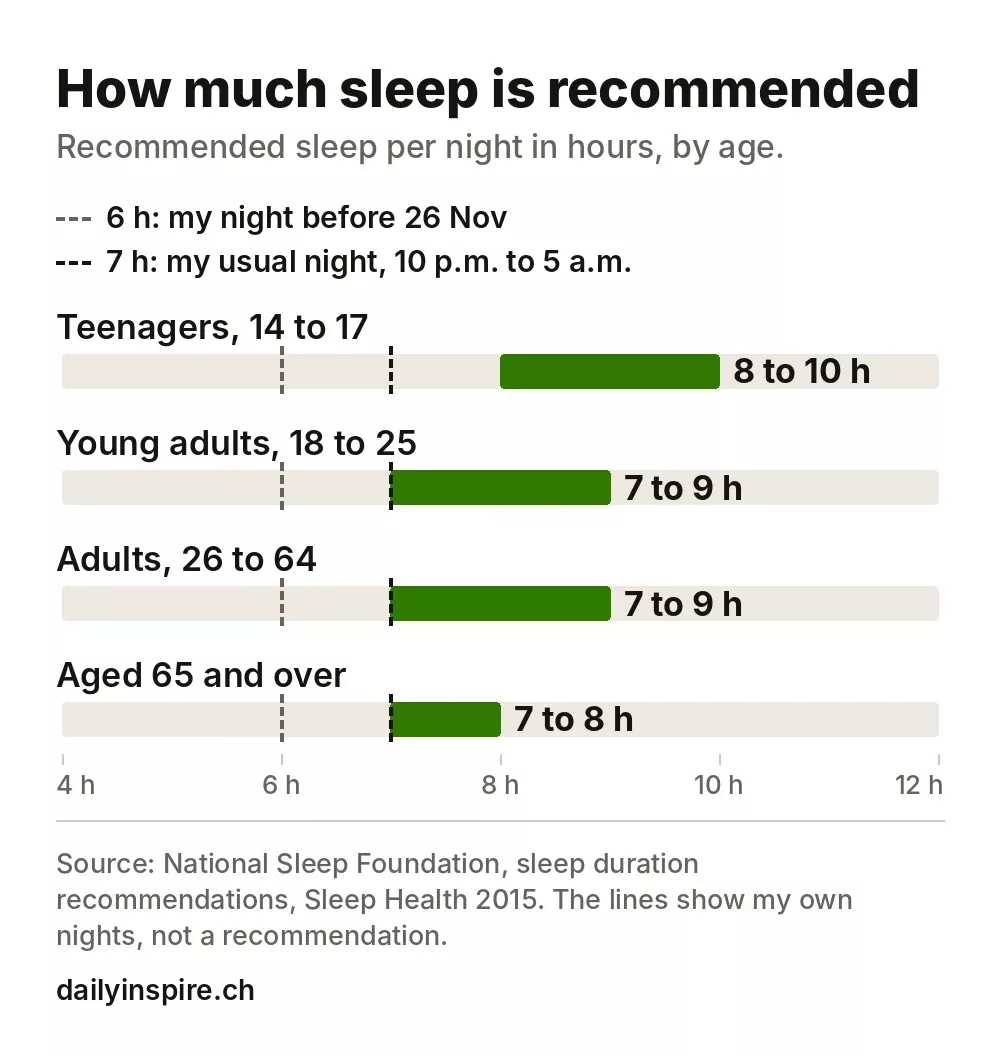
The National Sleep Foundation recommends 7 to 9 hours for adults and 7 to 8 hours from age 65 (Sleep Health, 2015). For adults, 6 to 7 hours "may be appropriate", and less than 6 hours is not recommended (National Sleep Foundation). So my 6 hours on 26 November were at the lower edge. For one night that's no drama. As a permanent state it would be too little.
Regularity matters almost as much as duration. In a study of more than 60,000 people from the UK Biobank, sleep regularity predicted the risk of death better than sleep duration. People with more regular sleep had a 20% to 48% lower risk of death than the group with the least regular sleep (Sleep, 2024). It's an observational study, not proof of cause and effect. That's why 5 a.m. is 5 a.m. for me every day.
Why do so many people in Switzerland sleep badly?
In 2022, a third of the population aged 15 and over said they had sleep disorders. In 1997 it was 28% (Federal Statistical Office). Women are affected more often than men, older people more often than young people.
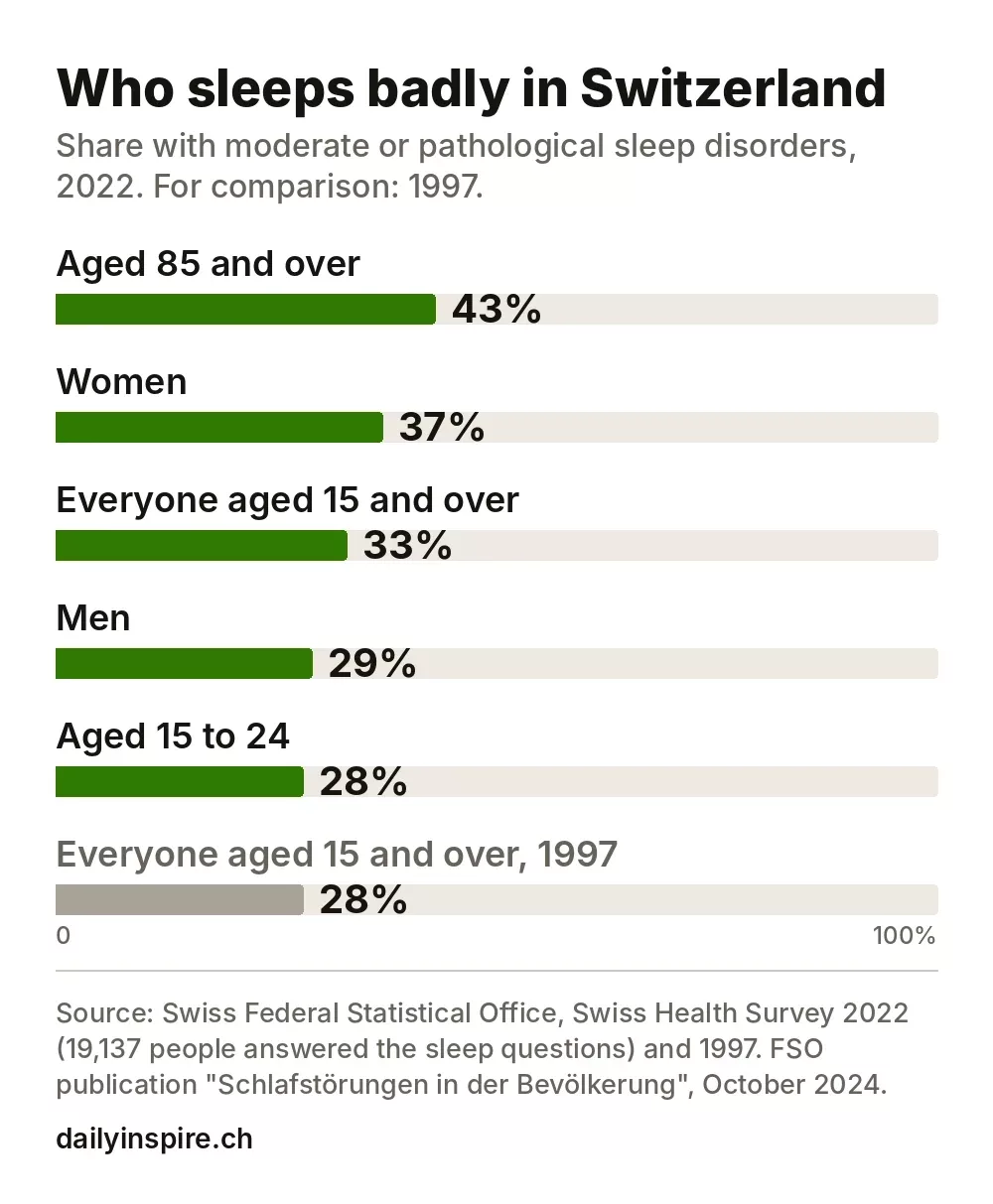
The sharpest rise was among young women. Pathological sleep disorders among women aged 15 to 39 rose from 3% in 1997 to 8% in 2022. 7% of the population had taken sleeping pills or tranquillisers in the week before the survey (FSO publication, 2024, in German).
There are now dedicated places for sleep. The Swiss Sleep House at Inselspital in Bern treats sleep disorders mainly with behavioural therapy (Sleep Bern). That's good for everyone who needs help. It still makes me sad. Sleep is really a second self. A second, beautiful life.
Why don't most people sleep from 10 p.m. to 5 a.m.?
Partly it's in the genes. A study of almost 700,000 people found 351 places in the genome linked to whether someone is a morning person. The 5% with the most "morning" variants sleep 25 minutes earlier on average than the 5% with the fewest. Age, sex and light also play a large role (Nature Communications, 2019).
Light in the evening shifts your inner clock. In one study, twelve adults read in the evening either on a light-emitting tablet or in a printed book. With the tablet they took almost 10 minutes longer to fall asleep, produced less melatonin and were less alert the next morning (PNAS, 2015). So a paper book isn't just cosier. More in "Sleep without the phone".
Then there's everyday life. Training, meeting friends and series all happen in the evening. And if you've been there for others all day, you often take your own time back at night. If you then get up early during the week and sleep until 10 at the weekend, you live with a permanent time difference. Experts call it social jetlag.
Do magnesium and taurine help you fall asleep?
They help me. Research is more cautious. A review of three studies of older adults with sleep problems found that with magnesium they fell asleep about 17 minutes faster on average. But the quality of the studies was low to very low (BMC Complementary Medicine and Therapies, 2021).
For taurine as a sleep aid there are even fewer good studies in humans. If you want to take supplements, talk to your doctor or pharmacist first, especially if you take medication or have kidney problems.
How do you get to 5 a.m. yourself?
Not in one jump. Under the 1% rule you get 1% better every day, in one of the three HMF areas. For getting up, that means small steps.
- Set your wake-up time and keep it every day.
- Count back 7 hours. For 5 a.m. that means being asleep at 10 p.m., not just going to bed.
- Shift the time in small steps, for example 15 minutes earlier per week.
- Do NULLRAUSCHEN before sleep: screen away, a calm book, a clear head.
- Get up as soon as the alarm rings. No snooze button.
What a short morning routine looks like after that is in "Your morning routine is too long".
Frequently asked questions
Is it unhealthy to get up at 5 a.m.?
Not if you sleep enough and regularly. It becomes unhealthy if you get up at 5 and still don't fall asleep until midnight. Then you're missing two hours every night.
Is 6 hours of sleep too little?
For single nights, not necessarily. As a permanent state, yes: regularly sleeping less than 7 hours is linked to weight gain, diabetes, high blood pressure, heart disease and depression, according to sleep medicine.
What if I still can't sleep?
If the problems last for weeks, see your GP. They can refer you to a sleep centre. For trouble falling or staying asleep, cognitive behavioural therapy works longer and with fewer side effects than sleeping pills, according to the Swiss Sleep House (Swiss Sleep House Bern, in German).
You spend almost a third of your life asleep. Treat it like a second life, not like a break.
More impulses
All posts
Burnout test at home: how I did it
57 out of 105 points, medium risk: how I took a burnout self-test, how many people in Switzerland are exhausted and which tests are actually validated.

Coffee with milk or black?
Does milk make your coffee worse? What studies from Lausanne and Zurich show, why coffee slows iron absorption either way and when coffee with milk becomes dessert.

Your date of birth is just a statistic. Your mind decides how old you are.
Calendar age is a number for the office. Many cells renew in weeks up to about 100 days. If you stay tired, you give new cells an old signal.