
Burnout test at home: how I did it
57 out of 105 points, medium risk: how I took a burnout self-test, how many people in Switzerland are exhausted and which tests are actually validated.
You can take a burnout test at home in a few minutes: one questionnaire, honest answers, the result written down with the date. It doesn't give you a diagnosis. It shows you how loud your alarm already is. This is not medical advice. I'm describing how I took the test, which questionnaires have been scientifically tested and what you can do afterwards in Switzerland.
How did I take the burnout test?
With the online self-test from München Klinik, in 2025, shortly before I moved. 21 questions, a few clicks, and there it was: 57 out of 105 points, "medium risk".
Nothing surprised me. Only how easy it was. A few simple questions, and TADA: a result. The test advised me to talk to someone I trust and to look at what was weighing on me.
Looking back, I really was slightly burned out after running a large company. I did a small reset. Today I'm doing better. I'm building a different company and slowly adjusting to the new conditions.
A test doesn't measure an illness. It measures how loud your alarm already is.
What does a burnout test actually measure?
It measures how strongly you feel the three features the World Health Organization uses to describe burnout: exhaustion, growing mental distance or cynicism towards your job, and reduced professional efficacy. The WHO classifies burnout as an occupational phenomenon, not as a medical condition (WHO, ICD-11).
How many people in Switzerland are affected?
There is no official figure, because burnout is not a diagnosis. Depending on the survey and the question, it's between 17% and 30%.
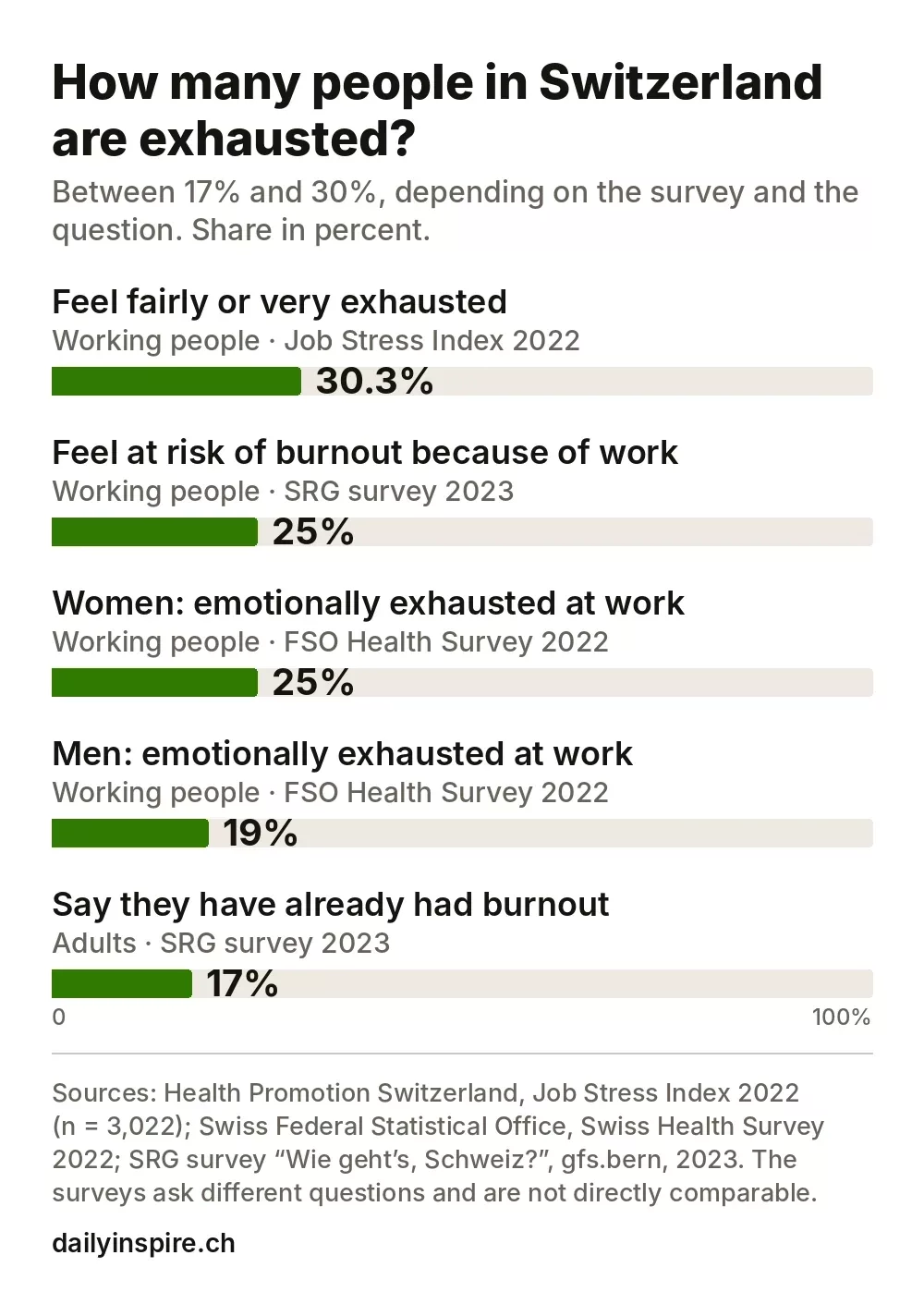
According to the Swiss Job Stress Index, 30.3% of working people felt fairly or very exhausted in 2022, more than 30% for the first time since 2014 (Health Promotion Switzerland, in German). In the 2022 Swiss Health Survey, 25% of working women were emotionally exhausted at work, up from 20% in 2012. Among men the share stayed stable at 19% (Federal Statistical Office, in German). In the 2023 SRG survey "Wie geht's, Schweiz?", 17% of adults said they had already had burnout, and a quarter said they felt at risk because of their job (swissinfo.ch).
The figures don't contradict each other. They measure different things: exhaustion is a warning sign, burnout is more. That's why a validated questionnaire beats a gut estimate.
Which burnout tests are scientifically validated?
Three questionnaires are well studied. The self-test I took is not one of them: it was developed by München Klinik's burnout specialists, and the clinic itself says it only allows a first rough assessment (München Klinik, in German).
| Questions | Test | What you should know |
|---|---|---|
| 12 or 23 | Burnout Assessment Tool (BAT) | free, in many languages; cut-offs from three European countries |
| 19 | Copenhagen Burnout Inventory (CBI) | free, also online in German; three scores: personal, work, clients |
| 16 to 22 | Maslach Burnout Inventory (MBI) | paid; the research classic |
| 21 | München Klinik self-test | free online, in German; only a first rough assessment |
If you only take one test, take the short BAT with 12 questions. It was developed at KU Leuven, and you can download it in many languages from one of its authors (Wilmar Schaufeli). The CBI is available in German as a free, anonymous online test from the association Pro Psychotherapie (therapie.de).
With the MBI it's harder. A review of 182 studies of physicians found 47 different cut-off scores for burnout. Same tool, 47 yardsticks (Scand J Work Environ Health, 2023).
How do you read your result?
The BAT-12 shows well how a validated test calculates. You read twelve statements about exhaustion, distance from work, concentration and emotions. For each one you say how often it applies, from 1 (never) to 5 (always). Your score is the average.
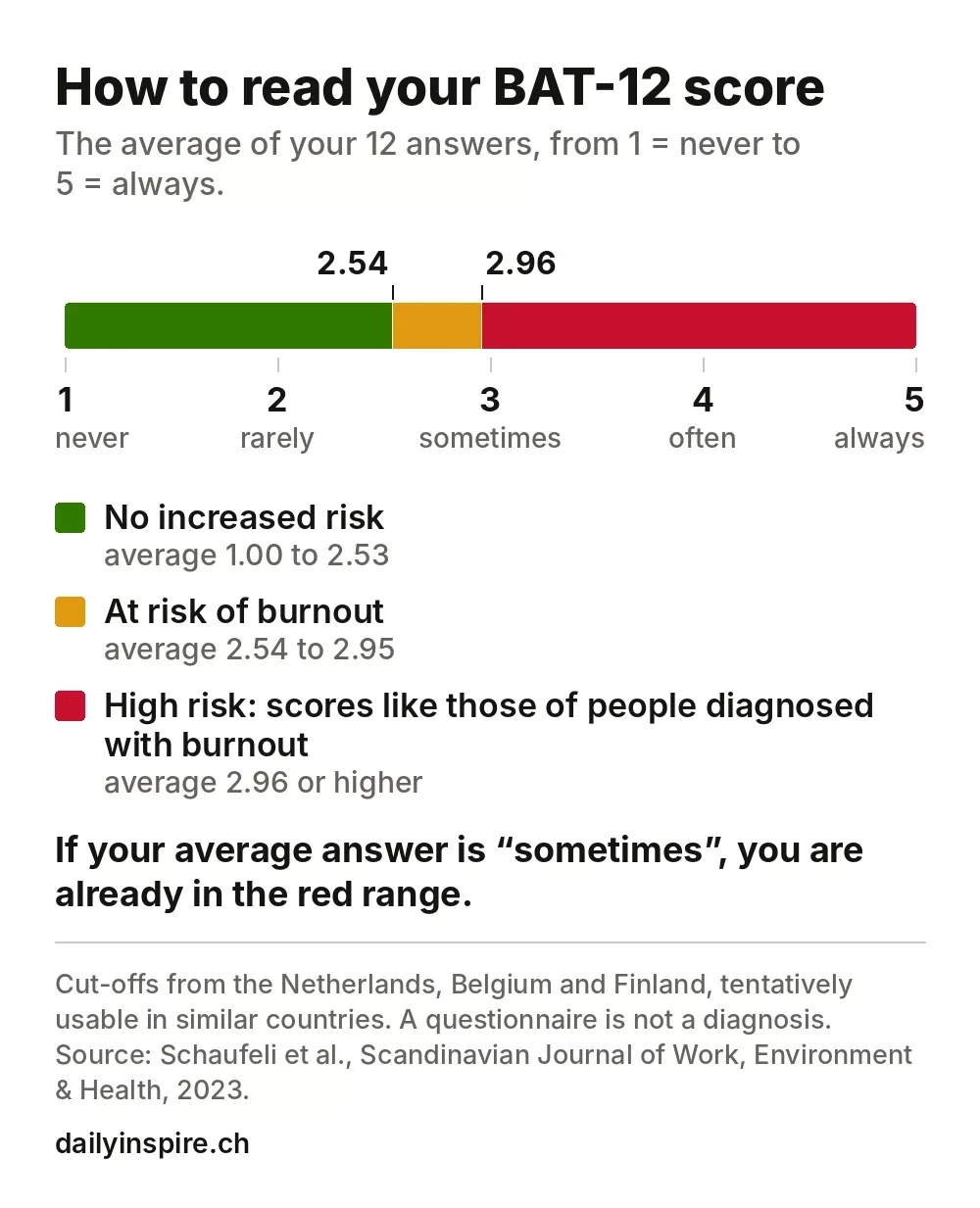
From 2.54 you are at risk. From 2.96 you are in the range where people diagnosed with burnout typically score. So if your average answer is "sometimes", you are already in the red range. The cut-offs come from the Netherlands, Belgium and Finland. The authors consider them tentatively usable in similar countries; they have not been tested for Switzerland specifically.
Does a test like this give real results? The BAT separates people diagnosed with burnout from healthy employees well to very well. Only the mental distance scale is less accurate (Scand J Work Environ Health, 2023).
Does a burnout test work online?
Yes, if the questionnaire is validated. In a study with students, the MBI, OLBI and CBI showed the same structure online as on paper (Computers in Human Behavior, 2011). The medium is rarely the problem. The problem is tests without a basis: some sites say "based on Maslach" but use their own questions and their own point scales. A good online test names the questionnaire and its source and explains how the score is calculated.
How do you take the test properly at home?
Calmly and honestly, otherwise you only measure this morning's mood.
- Choose a validated questionnaire, for example the BAT-12.
- Take ten minutes without your phone, on an ordinary day.
- Answer the questions for the past few weeks, not for last night.
- Write down the score with the date. A number without a date tells you nothing a month later.
- Take the same test again after four to six weeks. Only the same test is comparable.
- Talk about the result with someone you trust.
How to track a number over weeks without lying to yourself is in "You're playing without a score".
What do you do with a medium or high score?
You take it seriously without panicking. A medium score means: first warning signs. My result said the same: burnout develops slowly, and if you react early, you can prevent a lot.
Look at what is weighing on you and what you can change about it. Also check whether you still take any breaks between tasks. Why scrolling is not a break is in "You are not resting. You are numbing yourself." And if you've been trying to push through a wall for months: "You keep hitting the wall".
If the symptoms last longer or get worse, see your GP. A high score can also have other causes, such as depression, an anxiety disorder, a physical illness or a medication. No website can sort that out. If you're struggling right now in Switzerland: Die Dargebotene Hand, phone 143, around the clock and anonymous, also by chat at 143.ch.
Frequently asked questions
Who diagnoses burnout in Switzerland?
The first step is usually your GP. From there, if needed, you're referred on to psychiatry or psychotherapy. Bring your dated test result; it saves time in the conversation.
Does health insurance pay for psychotherapy in Switzerland?
Yes, basic insurance does, if a doctor prescribes it. Since 1 July 2022, psychological psychotherapists can bill basic insurance directly when a doctor has ordered the therapy (Federal Office of Public Health, in German). One order covers up to 15 sessions; more need a new order. You pay your deductible and co-payment as usual.
How often should I repeat the test?
Every four to six weeks is enough while you're changing something and want to see whether it works. Testing daily only measures how you feel that day.
Is burnout an illness?
Not according to the WHO classification: there it is an occupational phenomenon. The symptoms can still be serious, and then they belong with a doctor.
A test rarely tells you anything you don't already suspect. It just takes away the excuse of not knowing.
More impulses
All posts
Coffee with milk or black?
Does milk make your coffee worse? What studies from Lausanne and Zurich show, why coffee slows iron absorption either way and when coffee with milk becomes dessert.
Your date of birth is just a statistic. Your mind decides how old you are.
Calendar age is a number for the office. Many cells renew in weeks up to about 100 days. If you stay tired, you give new cells an old signal.
Affirmations without evidence are just talking to yourself.
"I am disciplined" in the mirror, and a voice laughs? Why positive statements can backfire and which three kinds of sentences work instead, including a values exercise.