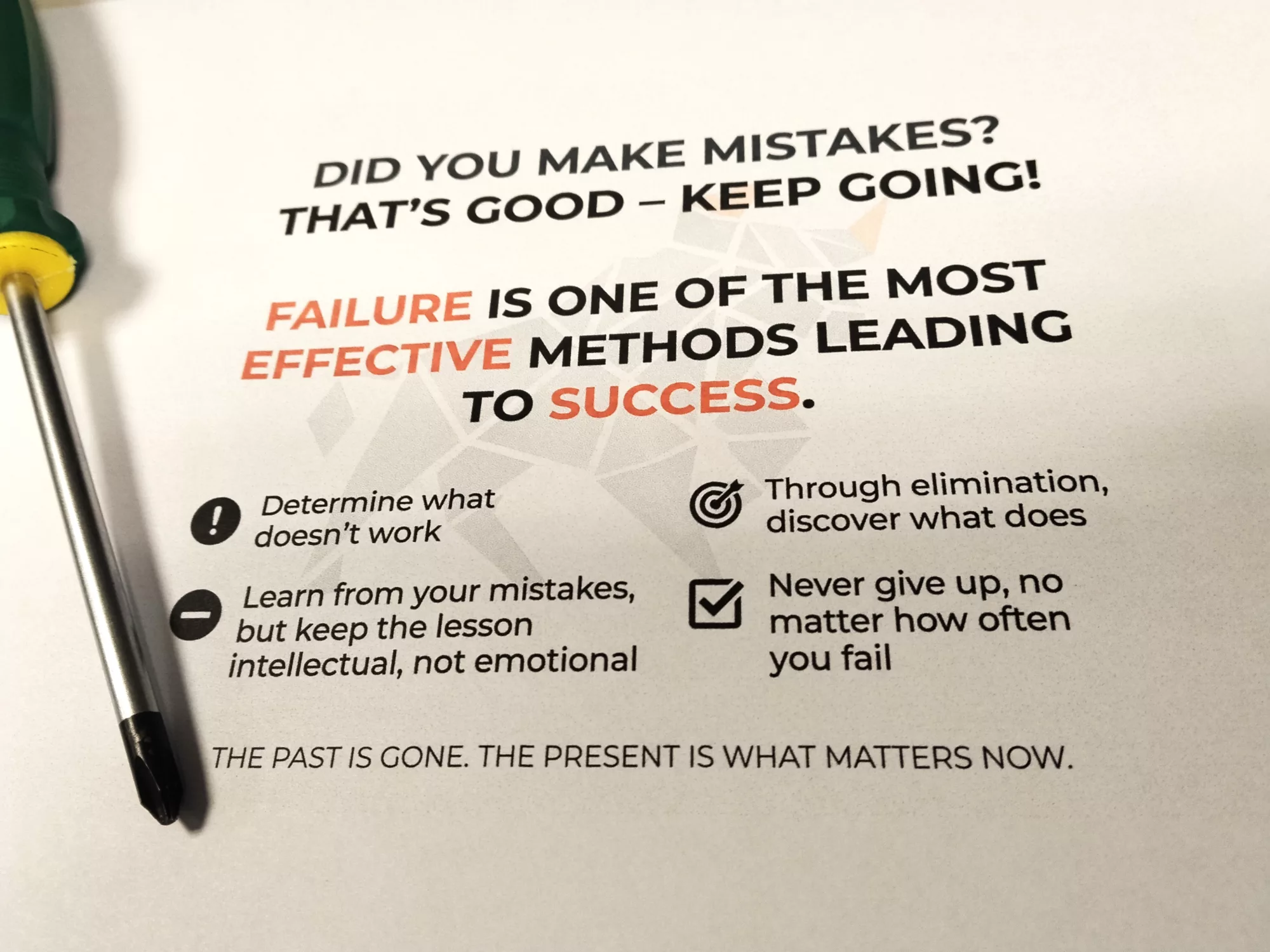
Overcome Fear: Your Fear Has No Veto.
You want to wait until the fear is gone? Then a feeling holds the veto. Name it, check the risk and take the next step you can answer for.
Key takeaways: Your fear has no veto. You do not have to feel fearless before you take a reasonable step. Name the fear, check the real risk and carry out an action you can answer for. An anxiety disorder is not everyday theatre. Then you get professional help.
You want to start once you are no longer afraid? Then you have handed a feeling the decision over your next step. Your fear sits at the entrance. You stand outside and wait for an invitation.
Victory always starts in the Head. It is a state of mind.
Victory always starts in the head. It is a state of mind.
You do not need a guarantee. You need a clear next step.
This can be organised differently. You do not have to feel fearless before you make a reasonable decision. You have to recognise what you are afraid of. You have to check the actual risk. And then choose a step you can answer for.
I know setbacks. I know new beginnings. DailyInspire V2.0 does not come from a spotless curriculum vitae. I am a human being, not a damned robot. That is exactly why I am not interested in the perfect façade. I am interested in the next usable step.
Today is not about hate, thoughts of revenge, envy, guilt or running from reality. Today is about fear. Above all it is about how much decision-making power you leave to it.
You are allowed to be afraid. You do not have to leave every decision to the fear.
Why is fear a warning signal and not an order?
Fear has a protective function. In real danger it is not an annoying defect. It is an important signal. Occasional fear belongs to life. A persistent, heavily burdensome anxiety disorder is something else.
Gesundheitsinformation.de puts it this way: every person is afraid sometimes, and in danger fear puts the body on alert. When fears take over, no longer disappear and overshadow daily life, an anxiety disorder may be behind them. The NHS says the same thing in one sentence: most people feel anxious sometimes. That does not automatically mean generalised anxiety disorder.
Whoever throws both into the same pot and sprinkles “pull yourself together” over it does not have a particularly hard philosophy. He has sorted badly.
This is about everyday situations in which fear of mistakes, fear of failure, or fear of rejection and judgement keeps you from acting. It is not about ignoring real dangers or pushing an illness aside with willpower.
I do not promise you that after this text you will never feel fear again. That would not be mentoring. That would be advertising with poor quality control.
The goal is not a life without any feeling of fear. The goal is more room to act.
How do you bring the fear into the light?
“Something is blocking me” sounds profound. For the next decision it is about as useful as an error message that reads: “Something is wrong.” Get more precise.
Write this sentence down and complete it:
I avoid __________, because I fear that __________.
For example: I do not send my offer, because I fear that the client will reject the price and consider me incompetent.
Now there is something on the table that you can examine. The client might reject the price. It does not automatically follow that he considers you incompetent. And even a critical judgement would still not be a final verdict on your worth as a person.
Separate the possible event from the story you have built around it. That story is often self-deception, not proof. What the pattern looks like is in the post The Pink Rabbit. Check the evidence for your fear and other plausible explanations. This checking of burdensome thoughts belongs to the cognitive self-help techniques that NHS Every Mind Matters describes for unhelpful thoughts.
Your head is allowed to supply scenarios. It does not yet get a stamp that says “fact”.
How do you look closely without diagnosing yourself?
Not every burdensome thought is obvious at once. For this exercise you do not have to develop a complete theory of your subconscious. Observe one concrete situation: What went through your head? What did you fear? What did you then do, or avoid?
The idea of an “infinite mind” is a spiritual interpretation. It does not replace a professional explanation of fear. For your next step you do not need a cosmic operating manual. You need an observation that is as honest as possible.
Inner restlessness, tension, withdrawal and physical complaints can be connected with fear. They do not prove a “hidden fear”. Physical symptoms can also have other causes. Gesundheitsinformation.de gives the example of a racing heart, which also occurs with an overactive thyroid or through certain substances. Have new, persistent or burdensome complaints checked by a doctor, instead of classifying them yourself, too quickly, as psychosomatic. The NHS says the same thing when you cannot safely assign a symptom to anxiety: see a doctor.
The task is: look more closely. The task is not: give yourself a diagnosis.
How do you act without switching off your mind?
You do not have to start with the hardest step. Choose a safe, manageable step in the direction you have been avoiding. Acting with courage and acting recklessly are not the same thing.
You are afraid to say something in a meeting? Then your next assignment is not to open an international conference tomorrow. At the next suitable opportunity, ask a factual question.
You are postponing an offer you have already checked, because you dread the answer? Check whether the necessary details are correct. Set a time to send it. Send it at that time, instead of trying yet another typeface.
The client is not buying a typeface. You know that. Your delay has merely developed a remarkable sense of typography.
Acting consciously means: you notice the fear and still decide on a step you can answer for. It does not mean jumping into every situation without preparation.
Discomfort is not an automatic stop signal. Real danger demands protection. With violence, dangerous activities or substantial risks, the rule is not “close your eyes and push through”. Protect yourself. Get support. Leave a dangerous situation.
Courage needs a working mind. Without it, all that remains is recklessness with a good advertising slogan.
Why do you repeat the action and not the escape?
Avoidance can bring short-term relief. In the long run, however, it can maintain or strengthen fears. NHS Every Mind Matters puts it directly: avoiding situations can make the fear worse. Facing a safe but feared situation step by step can help you experience more control again.
That is why it does not stop at one heroic solo performance.
Take the example from the meeting. You asked a question. Record what actually happened. Look for the next suitable opportunity. Repeat the step. Do not raise the difficulty out of impatience, but in line with what you can handle.
This is not an invitation to roll over yourself. A gradual approach belongs to established ways of dealing with fears. The World Health Organization describes exposure this way: people learn to face the situations that trigger their fear. Where an anxiety disorder needs treatment, this is applied with professional adjustment, not as a self-experiment based on feeling.
The sentence “I am afraid of it” should not become a lifelong ban. And the sentence “I did it once” should not become a permanent exemption from the next opportunity.
What do you measure when the heroic feeling stays away?
For your personal record, three questions are enough. A sensation is not yet proof that you completed the task you had been avoiding.
- What did I expect?
- What did I do?
- What actually happened?
Asking a factual question is an observable result. Sending an offer is one too. “Today I somehow felt stronger” is a sensation, but not yet proof that you completed the task you had been avoiding.
Do not judge yourself by the standard that every fear must disappear at once. Ask which step you carried out and what you learned from it.
A refusal belongs in the record too. You do not have to pretty it up. Check whether something can be learned from it about your offer, the timing or the need. Learn from the result. Do not use it as a verdict on your entire person.
Why do you laugh at the film in your head and not at yourself?
Your fear says: “If I ask a question, everyone will think I know nothing.” Your dry answer may be: “Of course Western civilisation collapses because of a follow-up question. It was only a matter of time.” That is the humour I mean.
You do not make your fear ridiculous. You make the exaggeration visible. The joke is aimed at the catastrophe script, not at the person who is suffering under it right now.
You are not ridiculous because your voice shakes. You are also not a failure because a refusal hits you. At DailyInspire we attack self-deception, not human dignity. How the inner conversation tips when the critic takes the chair is in Talking to Yourself.
Humour here is a stylistic device, not a cure. You do not have to laugh for your next step to count. But you also do not have to appoint every dark thought chairman of the board.
Ask it a sober question: “What evidence do you have for that?”
Your fear is allowed to be loud. It does not have to be right.
What do you control, and what is out of your hands?
You get no guarantee that nobody will criticise you. You get no guarantee that every decision will work out. And you get no unlimited time to wait for such guarantees. That is what rational fatalism means: accept what is outside your control. Take care of what you can influence.
You control the preparation of your conversation. You do not fully control the other person’s reaction. You control whether you send an offer you have checked. You do not control whether someone accepts it.
Do not confuse responsibility with omnipotence. Self-responsibility means: you take the part that is in your hands. It does not mean that you guarantee the result.
What is the mountaineering story good for, and what is it not?
In an unconfirmed mountaineering story, two members of a group of three fall to their deaths. The survivor is later asked whether he himself was afraid of death. His answer, in substance, is: every person must die at some point; he had to face that fact. Without a source that can be checked, this story is no use as evidence of fact.
As a parable it leads to an important distinction: recognising that life is finite does not mean holding your own life cheap. Someone who has understood his mortality does not, for that reason, take off the seat belt. He stops treating every limited uncertainty like an insurmountable wall.
You do not have to control everything. You have to deal responsibly with what is in your hands.
When do you get support?
If fear is persistently strong, clearly restricts your everyday life, or comes with recurring panic attacks, seek medical or psychotherapeutic support. Psychological and psychiatric professionals can sort the complaints and offer suitable help. Anxiety disorders are treatable. The World Health Organization speaks of highly effective treatments and says clearly: anyone with symptoms should get help.
A professional appointment is a concrete action. It counts no less just because no motivation video is playing. You do not have to dramatise your difficulties first in order to deserve support.
Common questions
Is fear always an order to stop?
No. Fear is a warning signal with a protective function. In real danger you protect yourself, get support or leave the situation. With fear of mistakes, rejection or judgement you check the risk and choose a step you can answer for. Discomfort alone is not a stop signal.
Do I have to be fearless before I act?
No. You have to name the fear, check the actual risk and choose a step you can answer for. Fearlessness is not an entry requirement. Whoever waits for it has given the feeling the veto.
What do I do when fear runs my everyday life?
If the fear is persistently strong, clearly restricts everyday life or comes with panic attacks, the next step is an appointment with a doctor or a psychotherapeutic professional. Anxiety disorders are treatable. This text is not a treatment plan.
May an old mistake block the next step?
An earlier mistake cannot be undone. Its consequences and its lesson belong in your procedure. It does not also get the right to block every new decision. What that means in practice is in Forget the Past!
Your task for today
Choose an everyday, safe situation that you have been postponing out of fear of mistakes or judgement. Then work through these five steps. You do not need a new notebook for it. The old paper can stand the truth as well.
- The fear: Write down which action you are avoiding and which concrete result you fear.
- The risk: Separate real dangers from assumptions. Clear open factual questions and the protection you need.
- The next step: Choose a small action you can actually do. Decide when and where you will carry it out.
- The execution: Carry out that step. Your assignment is the agreed action. It is not to look impressive while you do it.
- The review: Note the actual result. Adjust the next step to what you learned and repeat it.
This worksheet is a prompt for everyday delay caused by fear, not a treatment plan. If even small steps feel overwhelming, professional support is the next sensible step.
You do not need a final victory today over every fear in your life. You need an honest stocktake and a step you can answer for. After that you learn from the result.
On DailyInspire.ch that is exactly the point: not to appear flawless, but to take your own change seriously.
Your fear may come along. It does not automatically get the last word.